Description: white with a large red disk (representing the sun without rays) in the center
Geography
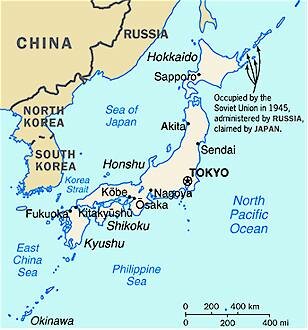
Location: Eastern Asia, island chain between the North Pacific Ocean and the Sea of Japan, east of the Korean Peninsula Geographic coordinates: 36 00 N, 138 00 E Map references: Asia Area: total area: 377,835 sq km land area: 374,744 sq km comparative area: slightly smaller than California note: includes Bonin Islands (Ogasawara-gunto), Daito-shoto, Minami-jima, Okinotori-shima, Ryukyu Islands (Nansei-shoto), and Volcano Islands (Kazan-retto) Land boundaries: 0 km Coastline: 29,751 km Maritime claims: exclusive fishing zone: 200 nm territorial sea: 12 nm; 3 nm in the international straits - La Perouse or Soya, Tsugaru, Osumi, and Eastern and Western Channels of the Korea or Tsushima Strait International disputes: islands of Etorofu, Kunashiri, Shikotan, and the Habomai group occupied by the Soviet Union in 1945, now administered by Russia, claimed by Japan; Liancourt Rocks disputed with South Korea; Senkaku-shoto (Senkaku Islands) claimed by China and Taiwan Climate: varies from tropical in south to cool temperate in north Terrain: mostly rugged and mountainous lowest point: Hachiro-gata -4 m highest point: Fujiyama 3,776 m Natural resources: negligible mineral resources, fish Land use: arable land: 13% permanent crops: 1% meadows and pastures: 1% forest and woodland: 67% other: 18% Irrigated land: 28,680 sq km (1989) Environment: current issues: air pollution from power plant emissions results in acid rain; acidification of lakes and reservoirs degrading water quality and threatening aquatic life; Japan's appetite for fish and tropical timber is contributing to the depletion of these resources in Asia and elsewhere natural hazards: many dormant and some active volcanoes; about 1,500 seismic occurrences (mostly tremors) every year; tsunamis international agreements: party to - Antarctic Treaty, Biodiversity, Climate Change, Endangered Species, Environmental Modification, Hazardous Wastes, Marine Dumping, Nuclear Test Ban, Ozone Layer Protection, Ship Pollution, Tropical Timber 83, Tropical Timber 94, Wetlands; signed, but not ratified - Antarctic-Environmental Protocol, Desertification, Law of the Sea, Tropical Timber 94 Geographic note: strategic location in northeast Asia
People
Population: 125,449,703 (July 1996 est.) Age structure: 0-14 years: 16% (male 10,121,414; female 9,644,243) 15-64 years: 69% (male 43,624,464; female 43,359,249) 65 years and over: 15% (male 7,737,781; female 10,962,552) (July 1996 est.) Population growth rate: 0.21% (1996 est.) Birth rate: 10.19 births/1,000 population (1996 est.) Death rate: 7.71 deaths/1,000 population (1996 est.) Net migration rate: -0.4 migrant(s)/1,000 population (1996 est.) Sex ratio: at birth: 1.05 male(s)/female under 15 years: 1.05 male(s)/female 15-64 years: 1.01 male(s)/female 65 years and over: 0.71 male(s)/female all ages: 0.96 male(s)/female (1996 est.) Infant mortality rate: 4.4 deaths/1,000 live births (1996 est.) Life expectancy at birth: total population: 79.55 years male: 76.57 years female: 82.68 years (1996 est.) Total fertility rate: 1.46 children born/woman (1996 est.) Nationality: noun: Japanese (singular and plural) adjective: Japanese Ethnic divisions: Japanese 99.4%, other 0.6% (mostly Korean) Religions: observe both Shinto and Buddhist 84%, other 16% (including Christian 0.7%) Languages: Japanese Literacy: age 15 and over can read and write (1970 est.) total population: 99% male: NA% female: NA%
Government
Name of country: conventional long form: none conventional short form: Japan Data code: JA Type of government: constitutional monarchy Capital: Tokyo Administrative divisions: 47 prefectures; Aichi, Akita, Aomori, Chiba, Ehime, Fukui, Fukuoka, Fukushima, Gifu, Gumma, Hiroshima, Hokkaido, Hyogo, Ibaraki, Ishikawa, Iwate, Kagawa, Kagoshima, Kanagawa, Kochi, Kumamoto, Kyoto, Mie, Miyagi, Miyazaki, Nagano, Nagasaki, Nara, Niigata, Oita, Okayama, Okinawa, Osaka, Saga, Saitama, Shiga, Shimane, Shizuoka, Tochigi, Tokushima, Tokyo, Tottori, Toyama, Wakayama, Yamagata, Yamaguchi, Yamanashi Independence: 660 BC (traditional founding by Emperor Jimmu) National holiday: Birthday of the Emperor, 23 December (1933) Constitution: 3 May 1947 Legal system: modeled after European civil law system with English-American influence; judicial review of legislative acts in the Supreme Court; accepts compulsory ICJ jurisdiction, with reservations Suffrage: 20 years of age; universal Executive branch: chief of state: Emperor AKIHITO (since 7 January 1989) is a constitutional monarch head of government: Prime Minister Ryutaro HASHIMOTO (since 11 January 1996) and Deputy Prime Minister Wataru KUBO (since 11 January 1996) were designated by the Diet and appointed by the emperor cabinet: Cabinet was appointed by the prime minister Legislative branch: bicameral Diet (Kokkai) House of Councillors (Sangi-in): half of the members elected every three years to six-year terms; elections last held 23 July 1995 (next to be held NA 1998); results - percent of vote by party NA; seats - (252 total, with 126 up for election) LDP 110 (49 newly won), Shinshinto 56 (40 newly won), SDP 38 (16 newly won), JCP 14 (8 newly won), Sakigate 3 (3 newly won), others 19 (4 newly won), independents 12 (6 newly won); note - the distribution of seats as of 1 March 1996 is as follows - LDP 111, Heisei-kai 69, SDP 35, JCP 14, Sakigake 3, others and independents 19, vacancies 1 House of Representatives (Shugi-in): all members elected every four years to four-year terms; elections last held 18 July 1993 (next to be held by July 1997); results - percent of vote by party NA; seats - (511 total) LDP 223, SDP 70, Shinseito 55, Komeito 51, JNP 35, JCP 15, DSP 15, Sakigake 13, others 4, independents 30; note - the distribution of seats as of 1 March 1996 is as follows - LDP 207, Shinshinto 170, SDP 63, Sakigake 22, JCP 15, others and independents 19, vacant 15 Judicial branch: Supreme Court, chief justice is appointed by the emperor after designation by the cabinet, all other justices are appointed by the cabinet Political parties and leaders: Liberal Democratic Party (LDP), Ryutaro HASHIMOTO, president and Koichi KATO, secretary general; Social Democratic Party (SDP), Tomiichi MURAYAMA, president and Kanju SATO, secretary general; Sakigake (Harbinger), Masayoshi TAKEMURA, chairman and Yukio HATOYAMA, secretary general; Shinshinto (New Frontier Party, NFP), Ichiro OZAWA, chairman and Takashi YONEZAWA, secretary general; Japan Communist Party (JCP), Tetsuzo FUWA, presidium chairman note: Shinshinto was formed in December 1994 by the merger of Shinseito (Japan Renewal Party, JRP), Komeito (Clean Government Party, CGP), Japan New Party (JNP), Democratic Socialist Party (DSP), and several minor groups; Heisei-kai is a joint bloc of Shinshinto and Komei members; Komei is a group formed from what remains of Komeito in the upper house International organization participation: AfDB, AG (observer), APEC, AsDB, Australia Group, BIS, CCC, CP, EBRD, ESCAP, FAO, G- 2, G- 5, G- 7, G- 8, G-10, IADB, IAEA, IBRD, ICAO, ICC, ICFTU, ICRM, IDA, IEA, IFAD, IFC, IFRCS, ILO, IMF, IMO, Intelsat, Interpol, IOC, IOM, ISO, ITU, MTCR, NEA, NSG, OAS (observer), OECD, OSCE (partner), PCA, UN, UNCTAD, UNESCO, UNHCR, UNIDO, UNITAR, UNRWA, UNU, UPU, WFTU, WHO, WIPO, WMO, WToO, WTrO, ZC Diplomatic representation in US: chief of mission: Ambassador Kunihiko SAITO chancery: 2520 Massachusetts Avenue NW, Washington, DC 20008 telephone: [1] (202) 939-6700 FAX: [1] (202) 328-2187 consulate(s) general: Agana (Guam), Anchorage, Atlanta, Boston, Chicago, Detroit, Honolulu, Houston, Kansas City (Missouri), Los Angeles, Miami, New Orleans, New York, Portland (Oregon), San Francisco, and Seattle consulate(s): Saipan (Northern Mariana Islands) US diplomatic representation: chief of mission: Ambassador Walter F. MONDALE embassy: 10-5, Akasaka 1-chome, Minato-ku (107), Tokyo mailing address: Unit 45004, Box 258, APO AP 96337-0001 telephone: [81] (3) 3224-5000 FAX: [81] (3) 3505-1862 consulate(s) general: Naha (Okinawa), Osaka-Kobe, Sapporo consulate(s): Fukuoka, Nagoya Flag: white with a large red disk (representing the sun without rays) in the center
Economy
Economic overview: Government-industry cooperation, a strong work ethic, mastery of high technology, and a comparatively small defense allocation (roughly 1% of GDP) have helped Japan advance with extraordinary rapidity to the rank of second most powerful economy in the world. One notable characteristic of the economy is the working together of manufacturers, suppliers, and distributors in closely knit groups called keiretsu. A second basic feature has been the guarantee of lifetime employment for a substantial portion of the urban labor force; this guarantee is slowly eroding. Industry, the most important sector of the economy, is heavily dependent on imported raw materials and fuels. The much smaller agricultural sector is highly subsidized and protected, with crop yields among the highest in the world. Usually self-sufficient in rice, Japan must import about 50% of its requirements of other grain and fodder crops. Japan maintains one of the world's largest fishing fleets and accounts for nearly 15% of the global catch. For three decades overall economic growth had been spectacular: a 10% average in the 1960s, a 5% average in the 1970s and 1980s. Growth came to a halt in 1992-95 largely because of the aftereffects of overinvestment during the late 1980s and contractionary domestic policies intended to wring speculative excesses from the stock and real estate markets. At yearend 1995, the financial structure is shaky with banks holding hundreds of billions of dollars of suspect assets. At the same time, the continued basic strength of the economy has been reflected in substantial trade surpluses, sizable foreign investments, and remarkably low rates of unemployment, inflation, and social disorder. The crowding of the habitable land area and the aging of the population are two major long-run problems. GDP: purchasing power parity - $2.6792 trillion (1995 est.) GDP real growth rate: 0.3% (1995 est.) GDP per capita: $21,300 (1995 est.) GDP composition by sector: agriculture: 2.1% industry: 40.2% services: 57.7% (1994) Inflation rate (consumer prices): -0.1% (1995) Labor force: 65.87 million (December 1994) by occupation: trade and services 54%, manufacturing, mining, and construction 33%, agriculture, forestry, and fishing 7%, government 3%, other 3% (1988) Unemployment rate: 3.1% (1995) Budget: revenues: $595 billion expenditures: $829 billion, including capital expenditures (public works only) of about $122 billion (1995 est.) Industries: among world's largest and technologically advanced producers of steel and non-ferrous metallurgy, heavy electrical equipment, construction and mining equipment, motor vehicles and parts, electronic and telecommunication equipment, machine tools, automated production systems, locomotives and railroad rolling stock, ships, chemicals; textiles, processed foods Industrial production growth rate: 3.3% (1995) Electricity: capacity: 205,140,000 kW (1993) production: 915 billion kWh (1995) consumption per capita: 7,293 kWh (1995) Agriculture: rice, sugar beets, vegetables, fruit; pork, poultry, dairy products, eggs; world's largest fish catch of 10 million metric tons in 1991 Exports: $442.84 billion (f.o.b., 1995) commodities: manufactures 97% (including machinery 46%, motor vehicles 20%, consumer electronics 10%) partners: Southeast Asia 38%, US 27%, Western Europe 17%, China 5% Imports: $336.09 billion (c.i.f., 1995) commodities: manufactures 52%, fossil fuels 20%, foodstuffs and raw materials 28% partners: Southeast Asia 25%, US 22%, Western Europe 16%, China 11% External debt: $NA Economic aid: donor: ODA, $11.259 billion (1993) note: ODA and OOF commitments (1970-95), $143 billion Currency: yen (¥) Exchange rates: yen (¥) per US$1 - 105.84 (January 1996), 94.06 (1995), 102.21 (1994), 111.20 (1993), 126.65 (1992), 134.71 (1991) Fiscal year: 1 April - 31 March
Transportation
Railways: total: 26,506 km standard gauge: 3,233 km 1.435-m gauge (entirely electrified) narrow gauge: 72 km 1.372-m gauge (72 km electrified); 23,154 km 1.067-m gauge (13,835 km electrified); 47 km 0.762-m gauge (47 km electrified) (1994) Highways: total: 1,112,844 km paved: 790,119 km (including 5,054 km of expressways) unpaved: 322,725 km (1992 est.) Waterways: about 1,770 km; seagoing craft ply all coastal inland seas Pipelines: crude oil 84 km; petroleum products 322 km; natural gas 1,800 km Ports: Akita, Amagasaki, Chiba, Hachinohe, Hakodate, Higashi-Harima, Himeji, Hiroshima, Kawasaki, Kinuura, Kobe, Kushiro, Mizushima, Moji, Nagoya, Osaka, Sakai, Sakaide, Shimizu, Tokyo, Tomakomai Merchant marine: total: 796 ships (1,000 GRT or over) totaling 15,944,137 GRT/23,662,930 DWT ships by type: bulk 192, cargo 57, chemical tanker 6, combination bulk 2, combination ore/oil 6, container 38, liquefied gas tanker 39, oil tanker 259, passenger 9, passenger-cargo 3, refrigerated cargo 35, roll-on/roll-off cargo 43, short-sea passenger 28, specialized tanker 2, vehicle carrier 77 note: Japan owns an additional 1,587 ships (1,000 GRT or over) totaling 50,072,815 DWT operating under the registries of Panama, Liberia, Vanuatu, The Bahamas, Singapore, Cyprus, Philippines, Hong Kong, and Malta (1995 est.) Airports: total: 164 with paved runways over 3 047 m: 6 with paved runways 2 438 to 3 047 m: 32 with paved runways 1 524 to 2 437 m: 34 with paved runways 914 to 1 523 m: 30 with paved runways under 914 m: 60 with unpaved runways 914 to 1 523 m: 2 (1995 est.) Heliports: 11 (1995 est.)
Communications
Telephones: 64 million (1987 est.) Telephone system: excellent domestic and international service domestic: NA international: satellite earth stations - 5 Intelsat (4 Pacific Ocean and 1 Indian Ocean), 1 Intersputnik (Indian Ocean Region), and 1 Inmarsat (Pacific and Indian Ocean Regions); submarine cables to China, Philippines, Russia, and US (via Guam) Radio broadcast stations: AM 318, FM 58, shortwave 0 Radios: 97 million (1993 est.) Television broadcast stations: 12,350 (1 kW or greater 196) Televisions: 100 million (1993 est.)
Defense
Branches: Japan Ground Self-Defense Force (Army), Japan Maritime Self-Defense Force (Navy), Japan Air Self-Defense Force (Air Force) Manpower availability: males age 15-49: 31,833,691 males fit for military service: 27,322,517 males reach military age (18) annually: 858,912 (1996 est.)
Defense expenditures: exchange rate conversion - $50.2 billion, 1% of GDP (FY95/96)